
Pakistan Budget 2025–26: In-Depth Economic Review and Tax Law Amendments Explained.
Pakistan’s Finance Minister unveiled the Budget 2025–26 on June 10, 2025, amid signs of global stabilization and strong macroeconomic performance at home. This blog unpacks every section—from the global economic backdrop to line-by-line tax code changes—so that business owners, investors, and concerned citizens gain clarity on how these measures affect growth, spending, and your bottom line.
Global Economic Review.
Growth & Inflation: After a series of shocks, global GDP expanded 3.3% in 2024, forecast to moderate to 2.8% in 2025 before rebounding to 3.0% in 2026. Inflation eased from 5.7% in 2024 to 4.3% next year, thanks to softer commodities—yet trade frictions and structural hurdles keep price pressures alive.
Trade Volume: World merchandise trade grew 3.8% in 2024, slowing to 1.7% in 2025 amid tariff uncertainty, before recovering to 2.5% in 2026. Emerging policy shifts underscore that global cooperation is key to resilience.
Why it matters to Pakistan: A stable global economy and easing inflation reduce import costs and support export demand—critical for a trade-dependent nation.
Pakistan’s Macroeconomic Stabilization
Primary & Fiscal Surpluses: For July–March FY2025, Pakistan delivered a 3.0% primary surplus and a 1.7% fiscal surplus (Rs 1.896 trillion)—the first fiscal surplus in 24 years.
Inflation & Interest Rates: CPI inflation plunged from 17.3% (April 2024) to 0.3% (April 2025), the lowest in six decades. KIBOR dropped nearly 10 percentage points to 11.3%, easing borrowing costs.
Debt Maturity & Reserves: The Average Time to Maturity of domestic debt lengthened from 2.9 to 3.5 years, reducing rollover risk. FX reserves climbed to US $16.64 billion by May 27, 2025.
Why it matters: Lower inflation and borrowing costs create an investment-friendly climate, while surplus budgets and higher reserves signal fiscal discipline.
Growth & Investment Dynamics.
Real GDP: Grew 2.68% in FY2025, driven by expansion across fiscal, financial, and external sectors.
Market Prices & Ratios: GDP at current market prices rose 9.1% to Rs 114.7 trillion. Investment-to-GDP hit 13.8%; savings-to-GDP reached 14.1%. Per-capita income rose 9.7% to US $1,824.
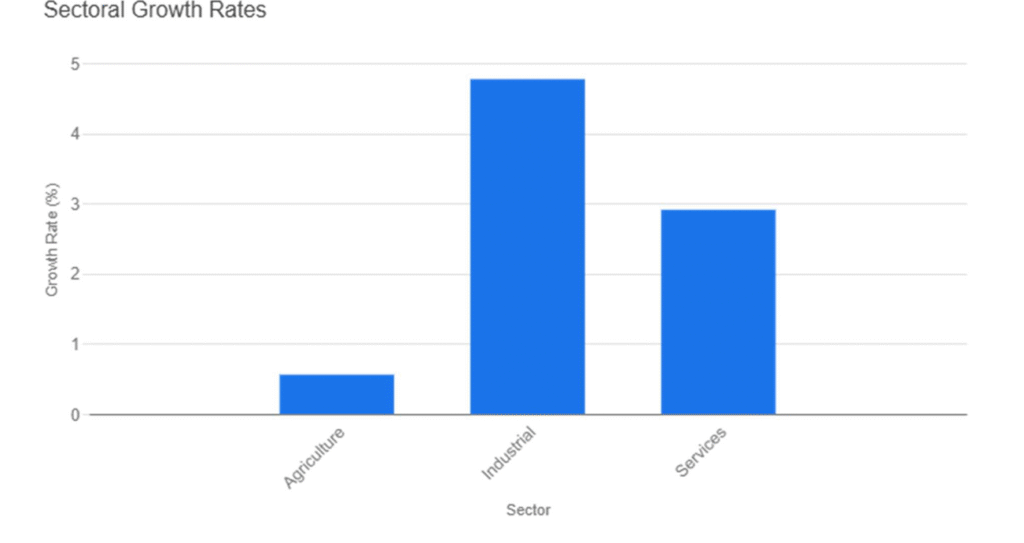
Sectoral Performance: Agriculture edged up 0.56%, industry jumped 4.77%, and services grew 2.91%—holding a 58.4% share of GDP.
Key takeaway: Balanced growth across sectors, coupled with higher savings and investment rates, underpins sustainable expansion.
4. Agriculture Sector Details
Crop output slipped 13.5% amid weather challenges: cotton (–30.7%), wheat (–8.9%), maize (–15.4%), sugarcane (–3.9%), rice (–1.4%).
Livestock—63.6% of agri-GDP—grew 4.72%; forestry +3.03%; fisheries +1.42%.
Implication: While crops face volatility, livestock and allied activities provide a buffer—highlighting the need for climate-smart practices.
Fiscal Development & Sustainability.
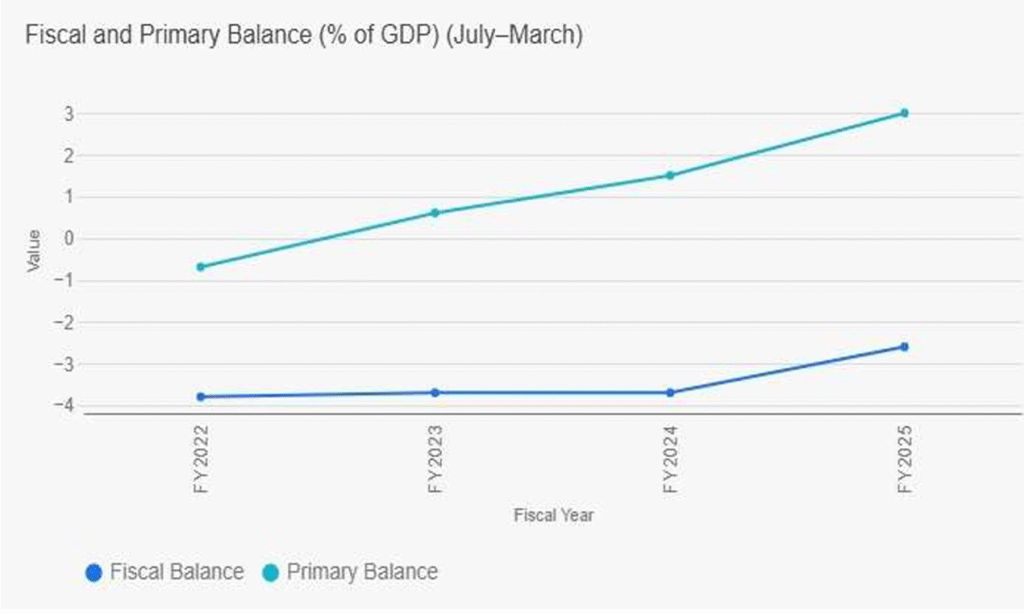
Q1 Surplus & Trajectory: From a 3.8% GDP deficit in FY2022 to a 2.6% deficit in July–March FY2025, with primary balance swinging from –0.7% to +3.0%.
Drivers: Ambitious province-coordinated reforms, revenue mobilization, and restrained non-interest spending.
Fiscal health boost: Surpluses and narrowing deficits signal Pakistan’s ability to finance development without excessive debt.
Capital Markets & Corporate Sector
KSE-100 Surge: +50.2% return (78,445 → 117,807), fueled by stabilized policy rates and IMF EFF success.
Savings Schemes: Net inflows of Rs 171.3 billion versus Rs 110.1 billion outflow last year.
New Incorporations: 26,104 companies registered (IT: 4,014; Trading: 3,457; Services: 3,137), capitalizing Rs 66.6 billion.
Commodity Futures: PMEX traded 5.88 million contracts (gold, oil, US indices) worth Rs 6.54 trillion (+60%).
Investor confidence: Strong stock performance and corporate activity reflect restored trust in Pakistan’s markets.
Inflation Landscape
Sharp Decline: CPI from 17.3% → 0.3% (April 2025).
Components: Urban food +1.1%, non-food +9.1%; rural food –1.5%, non-food +8.3%.
Headline Average: 4.7% (July–April FY2025) vs. 26.0% last year.
Policy impact: Tight monetary and fiscal stance, stable food supplies, and base effects drove benign inflation—relieving households.
Trade & External Payments
Current Account: US $1.9 billion surplus (July–April FY2025), versus US $1.3 billion deficit last year.
Trade Deficit: Goods gap widened to US $21.3 billion (+11.8% imports vs. +6.8% exports).
Remittances: Historic US $4.1 billion in March 2025; +31% year-on-year to US $31.2 billion.
External strength: Remittances and services surplus cushioned rising goods deficits, shoring up reserves.
Public Debt Management
Stock: Rs 76.0 trillion total (domestic Rs 51.5 trillion; external US $87 billion).
Financing: Fully met via long-term domestic securities; Rs 2.4 trillion T-bills retired.
Innovations: 2-year zero-coupon PIB; 1-month T-bill; Rs 1.6 trillion Sukuk issuance.
Benefit: Diversified instruments and extended maturities mitigate rollover and interest risks.
Social Sectors & Infrastructure
Education (Page 9): Literacy at 60.65%; Rs 61.1 billion for HEC projects; World Bank US $400 million grant for tech upgrades.
Health & Nutrition: Rs 924.9 billion health spend; Rs 103.5 billion PSDP allocation; SUN Youth Network for combating malnutrition.
Population & Employment: 241.5 million population; 56,000 youth trained in market-relevant skills.
Transport & Energy (Pages 10–11): Rs 161.3 billion for 105 highway projects; electricity capacity 46,605 MW; 80,111 GWh consumption.
IT & Telecom: US $2.83 billion ICT exports; 21.6% trade surplus growth; freelancers earned US $400 million.
Social Protection: Expanded BISP and cash transfers for vulnerable groups.
Holistic growth: Targeted investments in human capital, connectivity, and energy support inclusive, long-term development.
Budget Highlights & “At a Glance”.
Total Outlay: Rs 17.57 trillion (+1.88%).
Net Revenue: Rs 11.07 trillion (+12.9%).
Tax Receipts: Rs 14.13 trillion (+18.8% direct; +19.0% indirect).
Non-Tax Receipts: Rs 5.15 trillion (+5.0%).
Capital Receipts: Rs 2.87 trillion (+416%).
Provincial Share: Rs 8.21 trillion (+17.3%).
Quick view: These topline figures reflect ambitious revenue targets paired with disciplined spending.
Major Tax Law Amendments.
Salaried Individuals: New concessional slabs (1% & 11%-35% brackets) for those earning >75% from salary.
Pensioners (<70 yrs): 0–10 million exempt; 5% on income above.
Withholding & Profit on Debt: Rates on services u/s 153 raised to 6% (excluding IT); profit on debt ↑15%→20% for ATL; 35%→40% for non-ATL.
Digital Transactions Levy: 1–2% on e-commerce payments via banks/COD; final discharge of liability.
Depreciation & Amortization: Leasehold improvements amortized at 10% p.a.; intangible useful life ↓25→15 years.
Group Relief & Minimum Tax: Super tax slabs tweaked; carry-forward of minimum tax ↓3→2 years; group relief conditional on normal tax regime.
Non-Profit Orgs: Tables 1&2 merged; all NPOs must comply with Section 100C (returns, audits).
New Exemptions: ICC events, SEZ & STZ enterprises capped to June 30, 2035; cinema operations up to 5 years or June 2030.
Withdrawal of Exemptions: Pension commutation, voluntary pension withdrawals, VC company gains, FATA/PATA tax breaks post-June 2026.
Sales Tax & FED:
Sales Tax: Withholding ↑1→2% on online marketplaces & CoD; solar cell and low-cc car concessions removed; e-bilty and CTS definitions added; enforcement powers expanded.
FED: Plot transfer duty withdrawn; stricter seizure/confiscation for counterfeit stamps; appeal rights streamlined.
Customs (Page 21):
New slabs (5%, 10%, 15%); abolition of 3%, 11%, 16% bands; RD rates capped at 50%; CTS for cargo; CAUs, DEUs, and auction directorates established; courier de-minimis cut to PKR 500.
Tax takeaway: The budget balances relief—especially for salaried classes and exporters—with broader enforcement and digital-economy levies to widen the base.
What This Means for You
Businesses & Investors: Lower policy rates and surpluses signal stability—but prepare for higher digital-transaction levies and stricter compliance.
Salaried Professionals & Pensioners: Enjoy reduced slabs, but note new pension-tax rules from July 2025.
Entrepreneurs & SMEs: Incentives for SEZ/STZs and simplified company incorporations; watch digital withholding on e-commerce.
Non-Profits & Academia: Section 100C compliance is now mandatory; teachers & researchers get 25% rebate until 2025.
All Taxpayers: Expanded withholding agents (banks, courier services) and sharp audit powers mean every digital payment could trigger tax collection.